
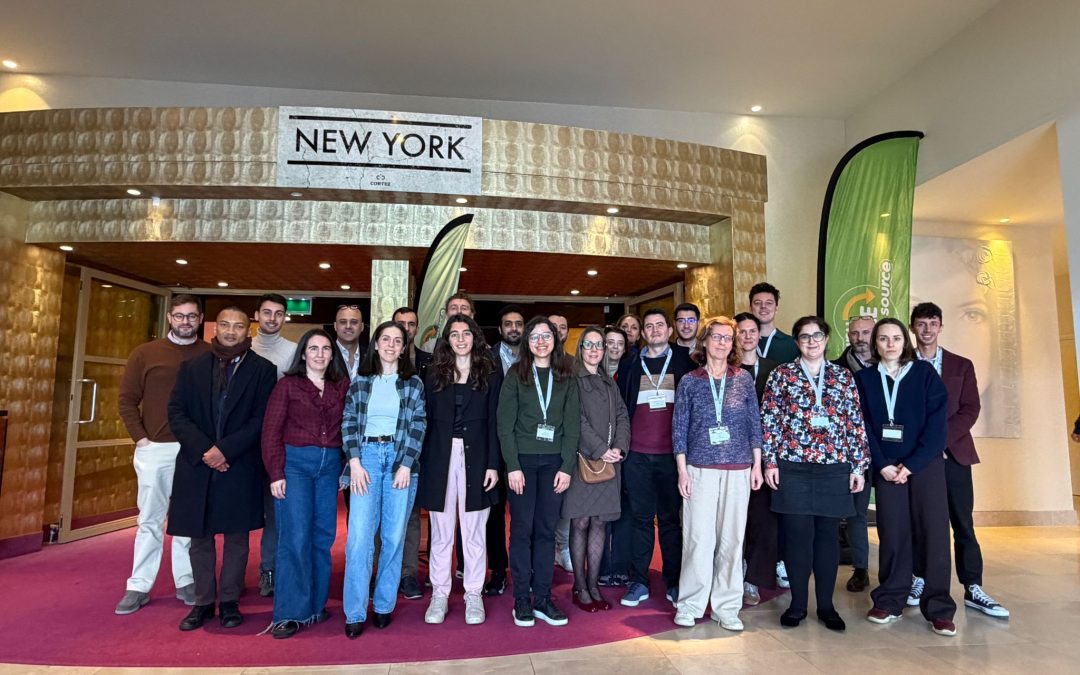
The seventh edition of ManuREsource, held from 4 to 6 March 2026 in Wageningen/Ede (the Netherlands), brought together more than 200 participants from 21 countries to discuss manure management, treatment, valorisation, nutrient recovery, and sustainability. Within this framework, the European project NUTRITIVE held its fifth consortium meeting and presented part of its scientific and technical progress.
ManuREsource once again confirmed its role as a leading platform for international exchange on manure surpluses, policy measures, treatment technologies, and valorisation pathways. According to the information provided by the organisers, this seventh edition delivered a broad overview of current developments in manure treatment technologies, energy production, and nutrient recovery, while also strengthening international cooperation and knowledge exchange in the field of manure management.
The overall focus of the event revolved around a shared challenge for public authorities, companies, and the scientific community: how to reduce losses to the environment and reuse nutrients and organic matter as efficiently and as highly as possible. In the conference material, organisers stress exactly that point: manure should not be seen only as a waste product, but as a valuable resource with agronomic, environmental, and energy potential.
Within that setting, NUTRITIVE’s participation was especially well aligned with the conference agenda. As explained by Leticia Regueiro, from Medrar and coordinator of the project, the consortium used the ManuREsource framework to hold its fifth meeting, focused on reviewing progress achieved up to month 24 and, above all, on strengthening the connections between the different work packages. According to her intervention, discussions centred on progress made between months 18 and 24, with both work package-specific meetings and parallel sessions designed to link technological results with environmental assessment, case studies, and the future decision-support tool.
That point is central to NUTRITIVE’s current stage. Leticia Regueiro explained that, after the progress made in recent months, it is no longer enough to develop technologies in isolation; it is now necessary to connect the outcomes of the different project solutions with the Life Cycle Assessment (LCA), the selected case studies, and the Decision Support System (DSS) being developed in another work package. In other words, the project is entering a phase in which integration becomes increasingly important: technologies, modelling, environmental assessment, and the final tool need to work together.
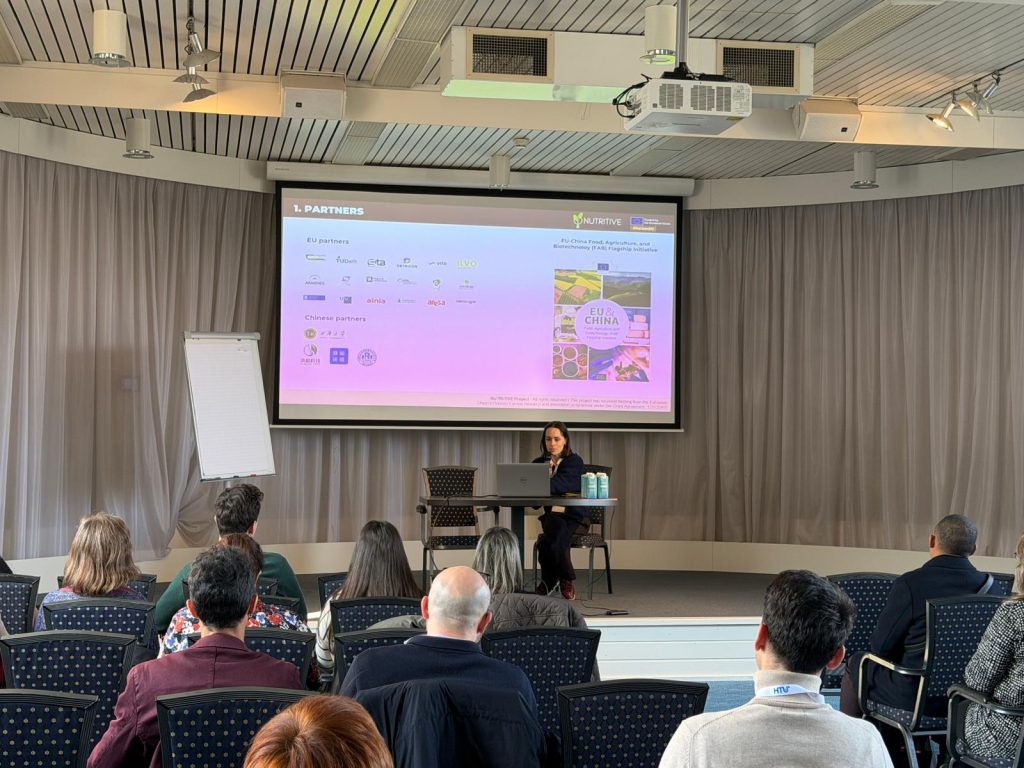
The project coordinator also highlighted that, within the conference programme, NUTRITIVE delivered a presentation on the DSS, which was “really appreciated” by people attending the conference, according to her own words in the transcript provided. In addition, she referred to progress made by several partners in specific areas: modelling, linked to partners such as VITO; the technological work associated with AINIA; Life Cycle Assessment, related to the Universidade de Santiago de Compostela; and other modelling and environmental technology contributions.
NUTRITIVE’s contribution to ManuREsource went beyond that presentation. During the event, several scientific posters were also displayed, offering a clear picture of the type of knowledge being generated within the project. One of them, presented by VITO, was entitled “Environmental fate modelling of manure-related pollutants” and focused on modelling the environmental fate of manure-related pollutants. The poster proposes a framework to simulate processes such as emissions from manure-treated soil, transport in soil, dilution of contaminants in groundwater, runoff to surface water, and the effects of different climatic and management scenarios. Its stated aim is to improve understanding of how these pollutants affect soil and water quality and to translate that knowledge into better management practices and decision-making.
A second poster, from the Universidade de Santiago de Compostela (CRETUS BioGroup), focused on antibiotic and antibiotic resistance gene contamination in water bodies close to manure-fertilised soils. The panel describes sampling design, the selection of resistance genes and antibiotics, and a methodology aimed at identifying their presence, assessing the effect of manure fertilisation on water quality, and relating those patterns to environmental and farming factors. Its content connects directly with one of the most relevant current concerns in livestock manure management: the potential movement of emerging contaminants from manure into the environment.
The third poster examined during the conference, also from the Universidade de Santiago de Compostela, was entitled “Are N₂O emissions only associated with AOB activity?”. It analyses nitrous oxide emissions in a PN reactor treating a simulated liquid fraction of cow manure digestate. The declared objective of the work is to evaluate N₂O emissions associated with ammonium-oxidising bacteria activity. In its conclusions, the poster states that N₂O emissions were strongly linked to that biological activity and rapidly decreased once ammonium oxidation ceased, while abiotic production was negligible even under high nitrite concentrations. This is a relevant result because it provides insight into the possible environmental trade-offs of specific treatment processes.
Taken together, NUTRITIVE’s participation in ManuREsource reinforces a broader point: the project is not only working on technologies, but on the articulation of a knowledge system able to determine which solution works best, for which contaminant, and under which conditions. Leticia Regueiro also made this clear when referring to the project’s next steps: identifying the best technologies for specific contaminants — such as heavy metals, pathogens, greenhouse gases, and nitrogen — and moving towards a possible technology train capable of removing the main pollutants associated with manure.
That approach fits closely with the spirit of ManuREsource 2026, where, according to the organisers’ information, sustainability, circularity, innovation, and efficient nutrient use were discussed from a triple helix perspective, bringing together policymakers, companies, and scientists. In that context, NUTRITIVE’s fifth meeting was not simply a side event, but an opportunity to review results internally, expose them to international technical discussion, and place them within a broader conversation about the future of manure management in Europe.
In that sense, ManuREsource has served NUTRITIVE as more than a showcase. It has also been a meeting point between science, technical validation, and strategic debate. This is especially important at a stage of the project where the key question is no longer only which technologies are delivering results, but how to combine them, assess them, and translate them into useful tools for more sustainable livestock manure management.