
Work Package 2
Work Package 2 of the NUTRITIVE project focuses on the demonstration and comparative assessment of innovative strategies and technologies applied along the manure management chain. The main objective of WP2 is to mitigate pollutants derived from manure. To achieve this, different technological solutions are being demonstrated and validated at laboratory and pilot scale, covering technology readiness levels (TRL) from 3 to 6, going from the reduction of greenhouse gases emissions, removal and/or recovery of nutrients, removal of heavy metals and removal of antibiotics, pathogens, antibiotic resistant genes and antibiotic resistant.
Significant results have already been achieved for several of the technologies under investigation.
There are some strategies focusing on reducing health and contamination risks at the earliest stages of manure and bedding management. Results show that proper management of recycled manure solids (RMS) bedding is critical to minimizing pathogen load and safeguarding animal health. Effective measures include regular bedding maintenance, strict control of humidity, and ensuring adequate pasteurization or composting processes. When these practices are applied consistently, RMS bedding can be safely managed, contributing to improved hygiene, reduced disease pressure, and overall enhanced sustainability of livestock systems.
As WP2 progresses towards field application, there are strategies for reducing ammonia emissions focusing on manure fertigation combined with the application of additives at field level. In this context, two application techniques were evaluated, as seen in Figure 1, conventional splash‑plate surface spreading, applied with and without additives, and low‑emission trailing shoe application.
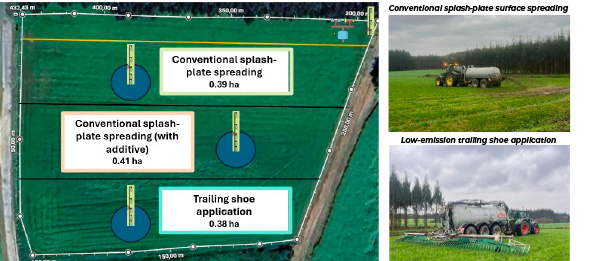
Figure 1. Field application.
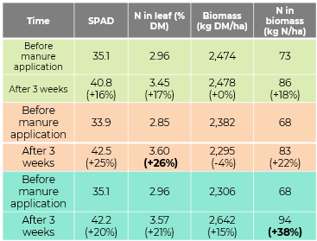
The results indicate a clear NH3 mitigation leading as it can be observed in Table 1 to increased chlorophyll content and higher nitrogen concentrations in plant leaves, confirming effective nutrient uptake. The use of additives resulted in a significant increase in leaf nitrogen content, higher compared to the conventional treatment without additives. In parallel, the low‑emission trailing shoe application showed a strong effect on early nitrogen uptake, achieving an increase of 38 %. Importantly, no visible phytotoxic effects were observed under any of the tested conditions, demonstrating the agronomic suitability of the strategies.
Table 1. Parameters before and after 3 weeks of manure application.
In the context of recovering nitrogen and phosphorus, successful results were achieved within microalgae. For nitrogen recovery, a sensor was created to determine free ammonia. Furthermore, it was proof the capacity of zeolite for desorbing ammonia. Moreover, electrocoagulation proved to get efficiencies up to 90 % for phosphorus removal from preliminary manure trials using both iron and magnesium sacrificial anodes.
Beyond these promising results, WP2 will carry out a comprehensive comparison of all strategies and technologies that are going to be tested throughout the project. This cross‑analysis will be highly valuable for identifying the most effective, sustainable, and applicable solutions along the manure management chain.